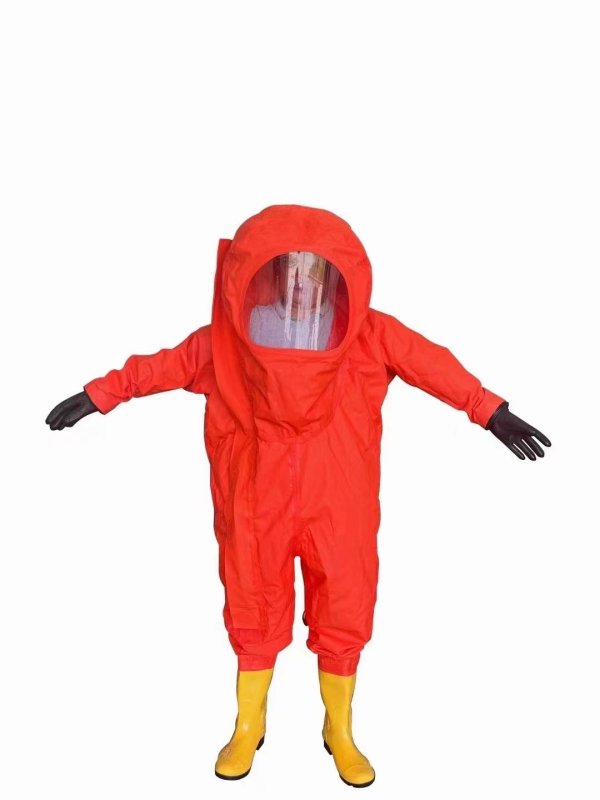
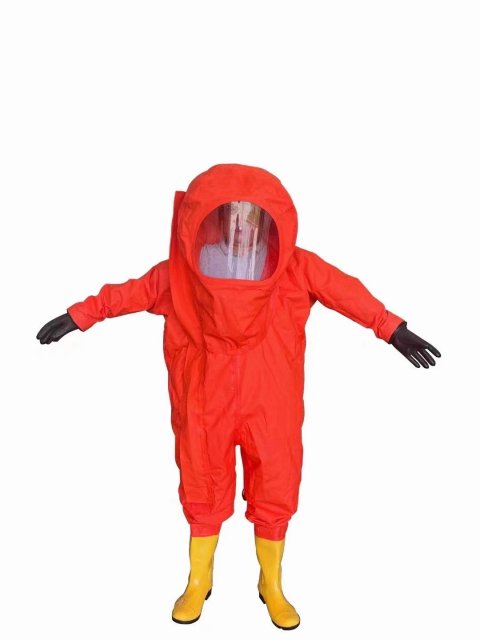
A one-piece encapsulating suit that covers the wearer head to foot, with a fixed hood, a wide panoramic visor and gloves sealed onto the sleeves. The body is cut wide through the shoulders and back so a breathing apparatus can be worn underneath, and the whole suit is finished in high-visibility red for a decontamination point where the wearer has to be picked out at a distance.
Full encapsulation — hood, torso, arms and legs are one continuous shell, so there is no waist joint or separate jacket for liquid to run into.
Panoramic visor — a large curved window in the hood rather than a narrow face opening, which keeps peripheral vision usable when the wearer is working with both hands.
Gloves attached at the sleeve — the black gloves are joined to the sleeve ends, so the wrist is not a gap that a splash can reach.
Wide back and shoulder cut — the back of the suit is shaped with space for a back-mounted air cylinder, which is why the rear panel stands proud of the body in the side view.
High-visibility red shell — a colour chosen so the wearer stands out at a decontamination shower or in smoke, rather than blending into the plant.
Elasticated ankle over boots — the trouser ends gather over yellow rubber boots, keeping the boot top covered while leaving the sole free.
Front closure under a flap — the opening runs down the front and is covered by a flap, so the closure is not the first surface a jet of chemical meets.
Worn with breathing apparatus — the design is intended for entry work where the air supply is carried by the wearer, not supplied from a fixed line.
| Type | Fully encapsulating chemical protective suit, one piece |
| Colour | High-visibility red |
| Hood and visor | Fixed hood with large panoramic visor |
| Gloves | Black gloves attached to the sleeves |
| Footwear | Worn with yellow rubber boots, ankle gathered over the boot |
| Closure | Front closure under a protective flap |
| Air supply | Cut to be worn over back-mounted breathing apparatus |
| Use | Chemical spill response and decontamination entry |
Chemical spill first response, tank and pipe repair entry, pesticide and solvent handling, hazardous waste clean-up, and the decontamination line itself, where the wearer passes through a shower still suited and the suit has to keep working while wet.

How to use the eye wash?
How to calculate the delivery time?
How to install the eye washer?
How to use the eye wash?
How to calculate the delivery time?
How to install the eye washer?
How to use the eye wash?
How to calculate the delivery time?
How to install the eye washer?
How to use the eye wash?
How to calculate the delivery time?
How to install the eye washer?
How to use the eye wash?
How to calculate the delivery time?
How to install the eye washer?
How to use the eye wash?
How to calculate the delivery time?
How to install the eye washer?